Drop Fade — What It Is and Who It Suits
A drop fade dips behind the ear and follows the curve of the head.
Walk-ins welcome · Mon–Sat 9–7, Sun 10–3 · (516) 328-0724
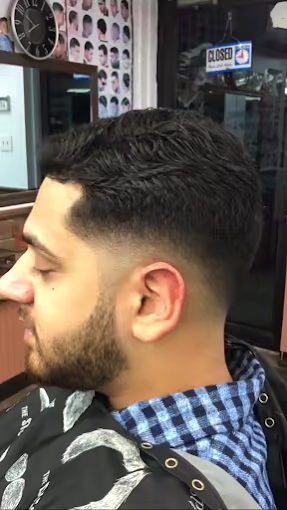
What a drop fade is
A drop fade is a fade whose line drops below the level it holds at the temple as it passes the ear, arcing down behind it and following the curve of the skull to the nape. A standard fade holds one height all the way around the head; a drop fade does not.
The reason it exists is anatomical. The back of a human head sits lower than the side at the same nominal height, so a fade cut as a straight horizontal line runs across the occipital bone and appears to climb as it goes round. Dropping the line behind the ear follows the bone instead of cutting across it, and the result reads as level even though it is not.
"Drop" describes the shape of the line, not its height. A drop fade can be low, mid or high at the temple and still drop at the back — so "mid drop fade" is a complete and sensible order.
Drop fade vs low fade
A low fade is straight and low everywhere. A drop fade can start anywhere on the side of the head and is defined only by the curve it takes behind the ear.
The practical difference is what happens at the back of your head:
- A low fade keeps the same height from temple to nape. On a head with a pronounced occipital bone the line can look as though it rises towards the back.
- A drop fade dips, usually by 2 to 4 cm, so the short section wraps the skull rather than crossing it. More of the back of the head is short.
- Grow-out is similar — 2 to 3 weeks for a drop, 3 to 4 for a low taper — but the drop's curved boundary blurs more gracefully than a straight one, because there is no straight line to go crooked.
Burst fade vs drop fade
If the back of your neck is faded, it is a drop fade. If it is long, it is a burst fade — the full comparison, with photographs of both, is on that page.
Why it works well with curly hair
A drop fade follows the direction hair naturally falls behind the ear, so the boundary is cut along the curl's fall rather than across it. A straight fade line through curly hair at the occipital creates a visible step, because each curl springs back a different amount and a hard horizontal edge exaggerates the difference.
Two mechanical notes that apply to any curl pattern:
- The same guard reads shorter on curly hair than on straight, because scalp shows between the coils. Ask for one guard longer than you would on straight hair.
- Judge it dry. Curly hair can sit at two to three times its dry length when wet, so a gradient that looks smooth wet can be a step dry.
What to ask for
The word that does the work is "drop", and the sentence that prevents the most common misunderstanding is naming the height separately:
"Drop fade please — start it mid at the temple and let it drop behind the ear, follow the curve down to the nape. Skin at the bottom, blend up to a two. Leave two fingers on top. Natural neckline."
| Decision | Options | In millimetres |
|---|---|---|
| Height at the temple | low / mid / high — say it, it is a separate decision | — |
| Shortest point | skin / #0.5 / #1 | 0 / 1.5 / 3 mm |
| The ladder | #1 → #1.5 → #2 → #3 | 3 → 4.5 → 6 → 10 mm |
| How far it drops | 2–4 cm is standard; "a deep drop" goes further | — |
| Neckline | natural / rounded / squared | — |
There is no special guard for a drop fade. The difference is entirely in where the barber sets the guideline — the first line cut, which everything else is blended from. Ask for "the guideline dropped behind the ear" if you want to be precise about it.
How often
A drop fade holds for 2 to 3 weeks. It sits in the same band as a mid or burst fade, and for the same reason: the shortest section is large enough that regrowth closes the gradient before the top needs anything done to it.
The curve buys you a few days over a straight line, because a blurred curve still reads as a curve and a blurred straight line reads as a mistake.
Who it suits
A drop fade flatters more head shapes than any other fade, because a curved line follows a skull and a straight one argues with it. If you do not know which fade to ask for and you want one, this is the safest thing to say.
- Hair type. Works on straight, wavy, coarse and curly hair. It is at its most useful on curly hair, for the reason in the section above.
- Head shape. Good on flat backs of heads, good on round ones, good where a straight fade has previously looked as though it was climbing.
- Pairs with anything with length on top — a textured crop, curls, a mid-length messy top.
Who it does not suit. If you have a pronounced occipital bump, the drop traces it and makes it more visible rather than less; a straight low fade covers it better. And on hair that is short all over, the drop is invisible — the curve only reads when there is length above it to contrast with.
Drop Fades we have cut
Every photograph here is a cut from our chairs. A style is missing only because we have not photographed it yet.
Visit us in Franklin Square
Franklin Square, NY 11010
(516) 328-0724
- Monday – Saturday
- 9:00 AM – 7:00 PM
- Sunday
- 10:00 AM – 3:00 PM
Walk-ins are welcome during all opening hours, and appointments can be made by phone.