Burst Fade — What It Is and What to Ask For
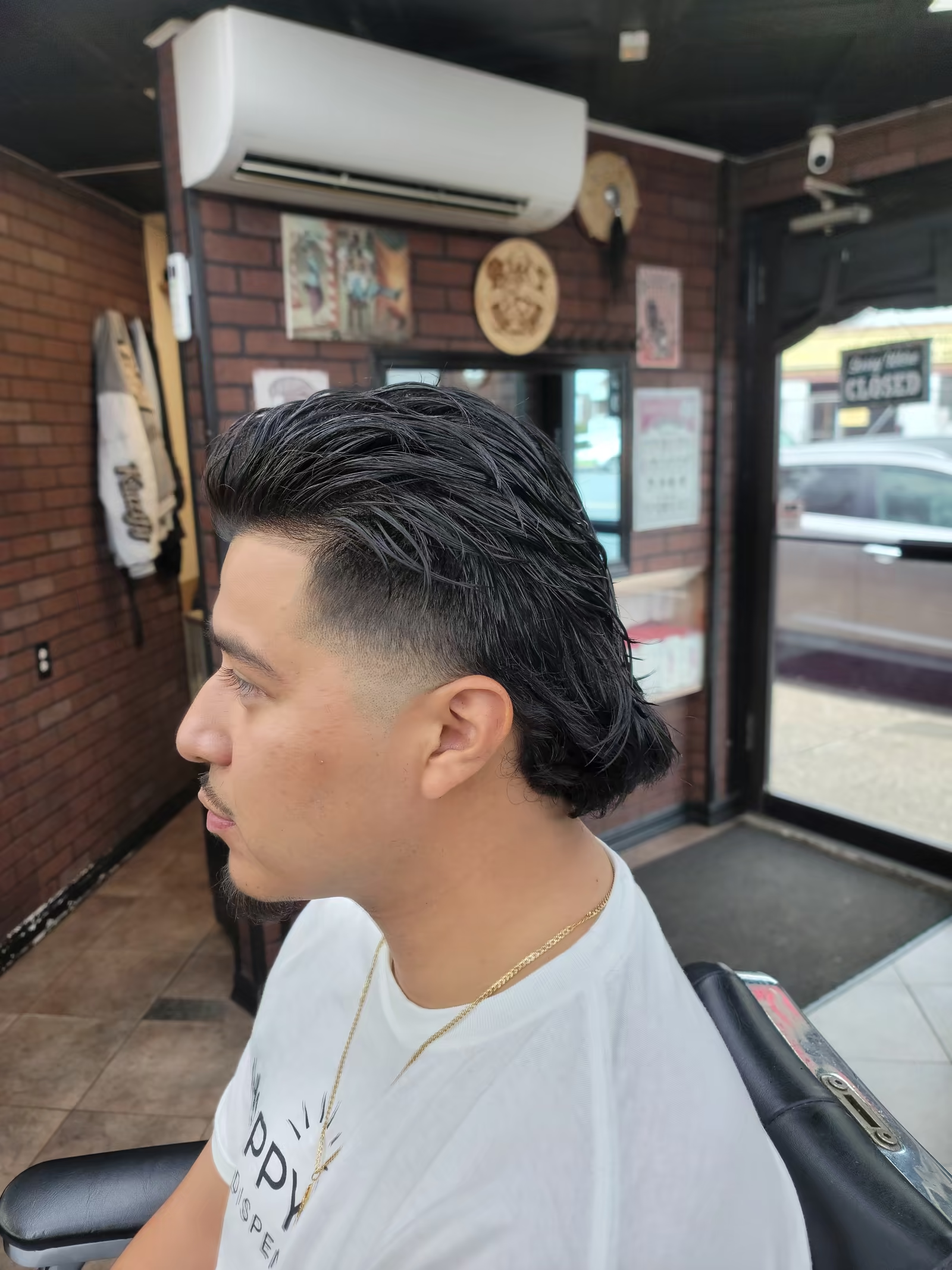
A burst fade curves in a semicircle around the ear rather than running straight down the sides.
Walk-ins welcome · Mon–Sat 9–7, Sun 10–3 · (516) 328-0724
What a burst fade is
A burst fade is a fade that curves in a semicircle around the ear and stops, instead of running all the way down to the neckline. The hair behind the ear and down the nape keeps its length — that is the one feature that separates it from every other fade.
Seen from straight behind, a burst fade looks like a full head of hair with a short arc at each ear. Seen from the side, it looks like a fade. That is why photographs of it taken from a plain side profile are usually useless: the shape only exists in three-quarter view.
It started as the fade that made mohawks and faux-hawks work, because it cleaned the sides without cutting into the length running down the middle. It is now the default ask for any cut with weight at the back.
Burst fade vs drop fade
A burst fade arcs around the ear and fades out before it reaches the back of the head, leaving the nape long. A drop fade runs all the way round but dips lower behind the ear, following the curve of the skull, and the nape is faded.
The one-line test: if the back of your neck is faded, it is a drop fade. If it is long, it is a burst fade. You do not need any other check.
| Burst fade | Drop fade | |
|---|---|---|
| Shape of the line | a closed arc around the ear | a continuous line that dips behind the ear |
| The nape | long, untouched | faded, short |
| From directly behind | reads as long hair | reads as a fade |
| Works with | mullets, faux-hawks, anything with length at the back | almost any silhouette |
| Squared neckline possible | no — the length is the point | yes |
If you want a clean, squared nape, you do not want a burst fade. Ask for a drop fade.
What to ask for
The two things to specify are how far the arc reaches and that the neckline is not to be touched — the second is the one that gets missed, and it turns the cut into something else.
"Burst fade around the ears please. Keep the length at the back and the nape — don't take the fade around the neckline. Skin at the ear, blend it out into the length within about two inches. Leave the top and the back as they are."
| Decision | Options | In millimetres |
|---|---|---|
| At the ear, shortest point | skin / #0.5 / #1 | 0 / 1.5 / 3 mm |
| Out through the arc | #1 → #1.5 → #2 | 3 → 4.5 → 6 mm |
| Radius of the arc | 4–5 cm is standard; say "stop it about an inch past my ear" | — |
| Behind the ear and the nape | untouched | — |
| Sideburn | the arc usually swallows it; say if you want it kept | — |
Measure the arc against your ear, not in centimetres. "Stop it an inch past my ear" is a reference every barber can act on; "make the burst small" is not.
Burst fade with a mullet
A burst fade is what makes a modern mullet wearable: it keeps a clean, short arc at the ears while the hair from the crown down the back stays long. Without it, the sides grow into the length and the cut loses its shape within a fortnight.
The failure mode is specific and worth naming out loud in the chair: a barber who fades the nape turns a mullet into a faux-hawk. The length down the centre-back is the mullet. Say "don't fade the nape" as a separate sentence.
"Burst fade at the ears, leave the back long from the crown down, keep the fringe, and don't touch the neckline."
Burst fade with curls
Curls sit well inside a burst fade because the arc follows the direction the hair already falls behind the ear, so the corner is not cut across the curl's natural fall. The tighter the curl pattern, the more forgiving the arc is of a slightly uneven blend.
One mechanical note that applies to any curl type: the same guard reads shorter on curly hair than on straight, because you see scalp between the coils. Ask for one guard longer than you would on straight hair and judge it dry.
How often
A burst fade holds its shape for 2 to 3 weeks. The arc is small, so regrowth blurs it quickly — but because the nape stays long, an overdue burst fade reads as slightly scruffy rather than obviously unkempt, which is more than most fades manage.
The tell is the edge of the arc. When you can no longer see where the short section ends and the length begins, the burst has closed.
Who it suits
A burst fade needs length behind the ear and at the nape to exist at all. If your hair is short all over, there is nothing for the arc to fade into and the cut simply reads as a bad fade.
- Suits oval and square faces, and any silhouette with weight at the back — mullets, faux-hawks, longer crops, curls worn long.
- Best on medium to thick hair. On fine hair the arc has nothing to blend into and the scalp shows in a ring.
- Does not suit anyone who wants a clean, squared nape — that is the opposite decision.
- On a very round face, the width left at the back and sides adds width where you may not want it; a mid fade takes it off instead.
- Be aware it is a dated-able shape. It is unmistakably a haircut of the last few years. If you want something that will not read as a specific year in photographs, a low taper will not.
Burst Fades we have cut
Every photograph here is a cut from our chairs. A style is missing only because we have not photographed it yet.
Visit us in Franklin Square
Franklin Square, NY 11010
(516) 328-0724
- Monday – Saturday
- 9:00 AM – 7:00 PM
- Sunday
- 10:00 AM – 3:00 PM
Walk-ins are welcome during all opening hours, and appointments can be made by phone.