High Skin Fade — What to Ask For and How to Keep It
What makes a fade high and what makes it a skin fade, who it suits, and the upkeep interval — the shortest of any fade.
Walk-ins welcome · Mon–Sat 9–7, Sun 10–3 · (516) 328-0724
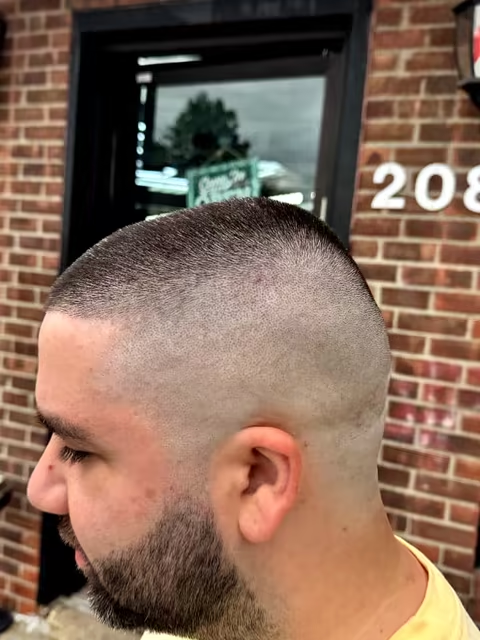
What makes it high, and what makes it skin
"High" describes where the gradient starts: at or above the parietal ridge, the corner where the side of your head turns into the top. "Skin" describes how short the shortest point goes: bare scalp, cut with a foil shaver or a lever-open blade rather than a guard.
They are two independent decisions, and every combination exists. A low skin fade is bare at the bottom and starts at the ear. A high taper is high up the head but leaves hair at the baseline. A high skin fade is both — the most extreme version of the cut, and the shortest-lived.
Find your own ridge before you sit down: lay a comb flat on top of your head and slide it outward. Where it stops touching your skull is the ridge, and on a high fade that is where the gradient blends out into the top.
High fade vs low fade
A high fade starts above the parietal ridge; a low fade starts at or below the top of the ear. Between them is roughly 6 to 8 cm of head, and the whole character of the haircut is in that gap.
- A high fade breaks your head into two shapes — a short one and a long one — with a visible boundary. It reads as a deliberate, current haircut and it photographs well.
- A low fade keeps one shape. It reads as a tidy haircut and it photographs like nothing at all, which for a lot of people is the point.
- A high fade compresses the entire gradient into a 5 to 7 cm band. That is why it is harder to cut well than a low one: the same number of guard steps have to happen in half the distance, so the half-guards and the lever do most of the work.
- A high fade at three weeks is a different haircut from the one you paid for. A low fade at three weeks is a slightly grown-out version of itself.
If the look appeals but the fortnightly appointment does not, ask for a high taper — the same height, hair left at the baseline — or a low taper fade if you also want the shape of your head left alone.
High and tight
A high and tight is a high fade with a short top — typically a #2 to #4, 6 to 13 mm, cut to one length — rather than the long top most high skin fades are worn with. It is a military cut and it reads as one.
The distinction matters when you order it: "high skin fade" leaves the top for a separate conversation, "high and tight" specifies both halves at once. If you ask for a high and tight and expect to keep 8 cm on top, you will be disappointed at the mirror rather than in the chair.
What to ask for
"High skin fade please. Take the skin up to just under the ridge and blend it out before the top — I don't want a hard line. Leave two fingers on top. Square the back."
| Decision | Options | In millimetres |
|---|---|---|
| Shortest point | skin (foil shaver / razor) | 0 mm |
| First step | lever-open blade | ~2 mm |
| The ladder | #1 → #1.5 → #2 | 3 → 4.5 → 6 mm |
| Blends out at | #3 into the scissor length | 10 mm |
| The boundary | "blend it out, no hard line" or "hard line at the ridge" | — |
| Neckline | square / rounded / natural | — |
Decide the hard line before you sit down. A blended high fade fades into the top with no visible edge; a hard-line high fade has a drawn boundary, sometimes razored. They look completely different and they are ordered with the same three words if you are not careful. Say which.
Guard millimetres vary by up to half a millimetre between manufacturers, and "skin" on a lever-adjustable clipper is not the same as skin from a foil shaver — the second is genuinely bare, the first leaves a fraction. If you want true skin, say "shaved, not clipped".
The upkeep is real
A high skin fade holds for 1 to 2 weeks — the shortest interval of any cut in this guide. The bare section shows stubble at 7 to 10 days and the gradient has closed by day 14.
That is not a sales line, it is arithmetic: hair grows roughly 1 cm a month, so a section cut to 0 mm is at 2–3 mm in a fortnight — which is a #1, and a #1 next to skin is a visible band rather than a fade. Nothing about your hair type changes this.
Before you book one, answer the honest question: can you come back every two weeks, all year? If the answer is no, a high taper or a mid fade gives you most of the look with a three-week cycle, and you will like your hair more of the time.
Who it suits
A high skin fade suits round and square faces, because the vertical emphasis lengthens them, and it suits thick, dense, coarse hair, because the contrast between skin and bulk is the entire effect. It is at its best on hair that stands up.
Who it does not suit — honestly:
- Long or oblong faces. Taking width off high on the head makes a long face longer. Go low.
- Fine or thinning hair at the crown. The contrast advertises exactly what you were hoping to play down; a #2 all over hides it and a high skin fade does not.
- Scalps with scars, moles, uneven pigment or ingrown-hair bumps. Skin means skin. Nothing is covered and you will see things you did not know were there.
- Coarse, tightly curled hair, if you are prone to razor bumps. Taking the nape to true skin on that hair type invites ingrown hairs. Ask for a 0.5 mm shadow instead of bare skin — it reads as skin from a metre away and avoids the problem.
- Anyone going into summer with a pale scalp. A bare section burns in about twenty minutes in June, and a burnt scalp under a fade peels visibly.
High Skin Fades we have cut
Every photograph here is a cut from our chairs. A style is missing only because we have not photographed it yet.
Visit us in Franklin Square
Franklin Square, NY 11010
(516) 328-0724
- Monday – Saturday
- 9:00 AM – 7:00 PM
- Sunday
- 10:00 AM – 3:00 PM
Walk-ins are welcome during all opening hours, and appointments can be made by phone.