Low Taper Fade — What to Ask For, and What It Looks Like
A taper leaves visible length at the baseline; a fade goes to skin.
Walk-ins welcome · Mon–Sat 9–7, Sun 10–3 · (516) 328-0724
What a taper fade is
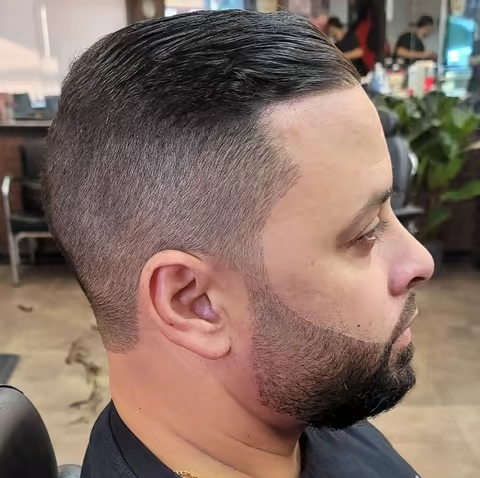
A taper is a short gradient confined to the perimeter of the haircut — the sideburns, around the ears and the nape — that gets shorter as it drops, while the bulk of the sides keeps its length. A low taper fade puts that gradient at the bottom of the head only: it starts at or just above the top of the ear, runs down to the hairline, and the hair at the very lowest point is still there, usually around 1.5 mm.
Everything above that band is untouched. That is what separates a taper from a fade in practice: a fade is a decision about the whole side of your head, a taper is a decision about its edge.
Taper vs fade — the actual difference
A taper leaves visible hair at the baseline. A fade takes the hair to skin. That is the whole distinction, and every other difference between the two follows from it.
The two words describe different variables, which is why they are constantly confused:
- "Taper" describes where. The gradient is limited to the perimeter — sideburn, ear, nape. It says nothing about how short the shortest point is.
- "Fade" describes how far. The gradient's shortest point is bare scalp. It says nothing about how high up the head the gradient starts.
- "Taper fade" is the hybrid both words point at: a perimeter gradient that goes very short but stops before skin.
The test you can do with your hand: run a finger up the back of your neck. If you can feel hair at the bottom edge, you had a taper. If you feel skin, you had a fade. There is no other check you need.
The consequence that actually matters is how they grow out. A skin fade at three weeks has a visible band where the bare section grew in at a different rate to the hair above it, and it reads as an overdue haircut from across a room. A low taper at three weeks just reads as shorter hair. That is the practical argument for a taper, and it is the reason it is the most-requested version of this cut.
Low, mid and high taper
Low, mid and high describe one thing: how high on the head the taper's gradient begins. The cut is otherwise identical — the same guards, the same tools, the same neckline decision.
Low taper
Starts at or just above the top of the ear and follows your hairline down and around. It removes no width from the head at eye level, which is why it suits every face shape and why it is the taper that reads conservative in a workplace. Holds 3–4 weeks.
Mid taper
Starts between the top of the ear and the temple corner — roughly at the widest point of the side of your head. It takes weight off at eye level, which narrows the head visually and makes the top look taller. Holds 2–3 weeks, because the short section is bigger and sits where people look.
High taper
Starts at or above the parietal ridge — the corner where the side of your head turns into the top. Find it by laying a comb flat on top of your head: where the comb lifts off the skull is the ridge. A high taper creates a hard visual break between the top and the sides while still leaving hair at the bottom edge, so you get a high-fade silhouette with a low-taper grow-out. Holds 2–3 weeks.
Low taper vs low fade
A low taper and a low fade start at exactly the same height. The difference is at the bottom: the taper leaves roughly 1.5 mm of hair at the lowest point, the fade takes it to bare skin with a foil shaver or a lever-open blade.
Three things follow from that one millimetre and a half:
- Contrast. A low fade shows scalp behind the ear and along the nape, so the edge reads as a drawn line. A low taper has no line — it reads as hair getting shorter.
- Grow-out. The fade needs re-cutting at 2 weeks to stay clean; the taper holds 3–4.
- Skin. A bare section on a scalp with ingrown-hair bumps, moles, scars or uneven pigment puts all of it on display. A taper covers it.
If you like the look of the fade but cannot get back inside a fortnight, a low taper is the cut you actually want.
What to say to your barber
Say this, out loud, in this order. It contains every decision, and none of it can be misheard:
"Low taper fade please. Keep the length on the sides — just taper the sideburns, around the ears and the neckline. Take the bottom edge down to a one, blend up to a two, and leave the top alone. Natural neckline, not blocked. Square my sideburns off level with the middle of my ear."
Swap the specifics for your own:
| Decision | Ask for | In millimetres |
|---|---|---|
| Bottom edge — softest | #1 guard | 3 mm |
| Bottom edge — standard | #0.5 guard | 1.5 mm |
| Bottom edge — hardest without going to skin | bare blade, no guard | ~1 mm |
| The blend above it | #1.5 into #2 | 4.5 mm into 6 mm |
| The sides above the taper | untouched, or #3+ | 10 mm and up |
| Neckline | "natural" / "rounded" / "squared" | — |
| Sideburns | "square" / "rounded", and where they end | — |
Guard millimetres vary by up to about half a millimetre between clipper manufacturers, and an adjustable-lever clipper cuts shorter with the lever closed than open. The figures above are the standard Wahl and Andis attachment sizes and are what a barber will assume you mean.
Say "natural neckline" unless you know you want a squared one. A squared nape holds a sharp edge for about ten days and then grows into a visible block that needs cutting off. A natural neckline grows out invisibly, which is the point of a taper in the first place.
How often to get it cut
A low taper fade holds its shape for 3 to 4 weeks. A mid or high taper holds 2 to 3, because the gradient is larger and sits at eye level where regrowth shows.
The tell is your sideburn, not your top. When the bottom edge of the taper is no longer visibly shorter than the hair above it, the taper has closed up and the cut is due — usually a day or two before you would have noticed it anywhere else.
The neckline goes first, at 10 to 14 days. A shape up haircut at $15 re-cuts the neckline and the sideburns without touching the length, and buys you roughly two more weeks out of the same cut.
Who it suits
A low taper fade suits every face shape, and that is the reason it is asked for more than any other fade. It removes no width at the temples, so it does not lengthen a long face, and it adds no height, so it does not exaggerate a round one.
- Hair type. Works on straight, wavy and coarse hair. On fine or thinning hair it is the safest fade of all, because nothing goes bare and the scalp never shows.
- Workplaces. Nothing is bare and nothing is high. If you have been told a haircut was "too much", this is the one that is not.
- Growing a fade out. A low taper is the halfway house — it keeps the perimeter clean while the sides catch up with the top.
Who it does not suit. If you want hard contrast between a long top and short sides, a low taper will not give it to you — the sides stay long and the silhouette stays soft. Ask for a mid fade or a high skin fade instead. It also does very little for you if your hair is already short all over; a taper needs length above it to taper from.
Price and who cuts it
A low taper fade is booked as a fade haircut — $30. Add a beard trim at $15 in the same sitting.
Low Taper Fades we have cut
Every photograph here is a cut from our chairs. A style is missing only because we have not photographed it yet.
Visit us in Franklin Square
Franklin Square, NY 11010
(516) 328-0724
- Monday – Saturday
- 9:00 AM – 7:00 PM
- Sunday
- 10:00 AM – 3:00 PM
Walk-ins are welcome during all opening hours, and appointments can be made by phone.